Skip to content
TaleQuest

Short story generatorEvery story starts with one line.

A complete short story — beginning, middle and end — in seconds. Pick the length, genre and voice.

CustomizeMystery · Short · Third person
Genre
Length
Point of view
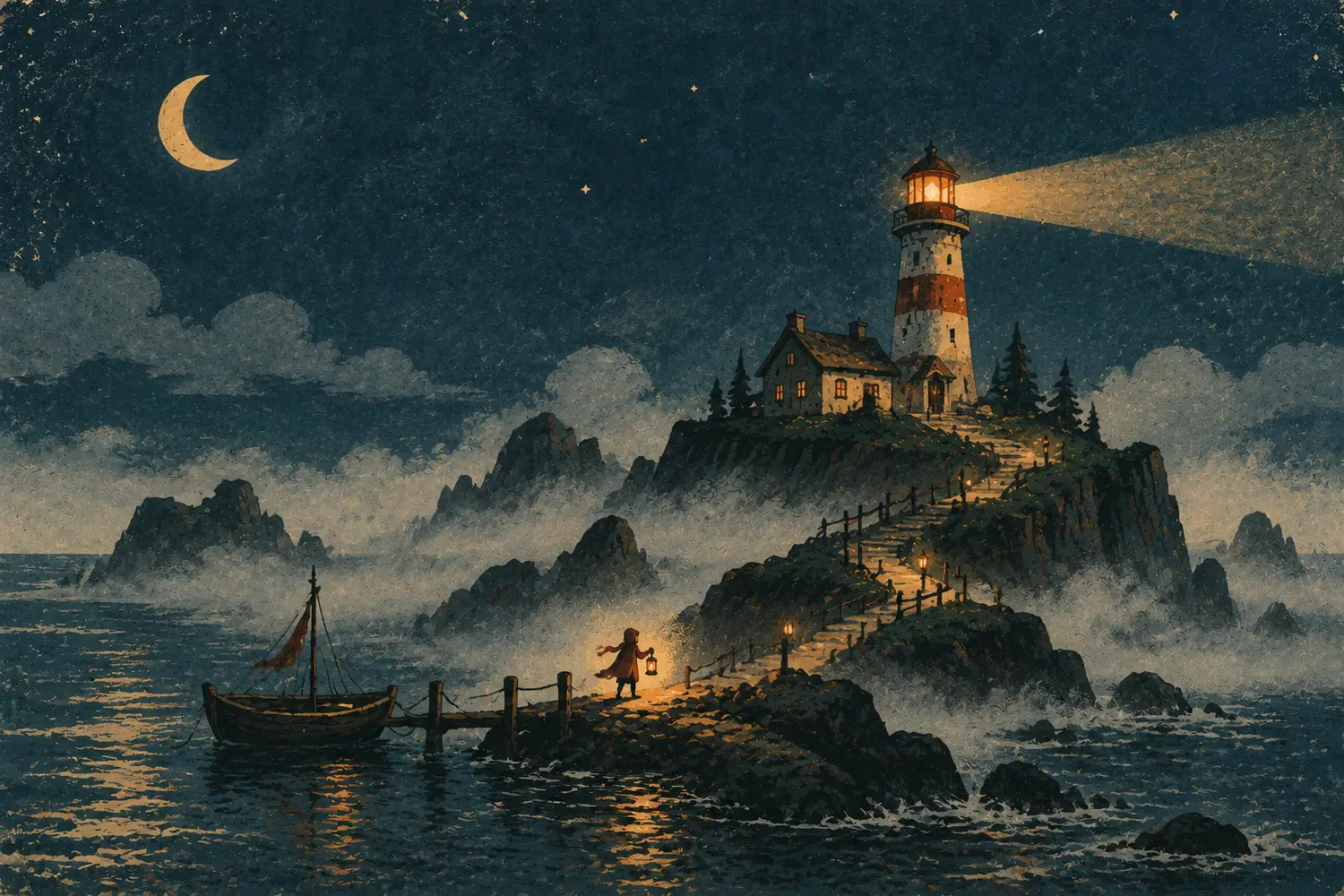
A figure with a lantern climbs the steps from a moored boat to a lighthouse on a foggy island at night
Original TaleQuest art · Mystery

Four ways to begin

Tap one and it goes straight into the box above. Change any word you like.

The Vanished Conductor

The night express to Harrowmere groans through the dark countryside, its carriages swaying as you grip the brass rail of the corridor. Lantern light flickers over faded velvet seats and rain-streaked windows. Ahead, the door to the conductor's compartment stands slightly ajar, and a thin ribbon of cold air slips out from it. On the carpet beside the threshold lies a single silver button, freshly torn from a uniform coat. Tucked into the frame of the door, a small brass key hangs from a loop of red thread. Behind you, a porter's voice calls out, asking whether the conductor has come through, and his tone sounds worried, not annoyed. The train slows with a shudder; through the glass you glimpse a dark station platform sliding past with no lamps lit at all.

A real opening scene

Then you choose what happens

This scene was written by TaleQuest from one line: You are a junior detective on a night train where the conductor has vanished between two stations.

Pick a branch and the story carries on from there, in your own tale.

In short: TaleQuest's short story generator writes a complete short story — beginning, middle and end — from one line in seconds. Pick about 300, 700 or 1,200 words, any of six genres and first, second or third person. It's free for 10 stories a day with no sign-up, and you can continue, rewrite or export each one.

Updated 2026-10-19 · by the TaleQuest team · Facts

Real examples, written by TaleQuest

Unedited output from the same free tool above. Your prompt gives you a different story every time.

Mystery · story

The Loaf on Cobble Street

Prompt: A small-town baker finds a coded note baked into a loaf she never made.

Marisol Dane arrived at Hollis Bakery before dawn, as she always did, her boots crunching frost on the cobbles. The shop smelled of yeast and cinnamon. Her apprentice, Tobin, was still asleep upstairs, and the ovens ticked as they warmed.

On the cooling rack sat a single round loaf, dusted with flour, its crust crackled gold. Marisol frowned. She had shaped every loaf the night before, and she had counted them twice. This one was new.

She broke it open. Inside, pressed into the crumb, was a folded slip of paper, dry as parchment. Symbols marched across it in tidy rows: a crescent, a bell, three dots, a key. Beneath them, in careful ink, were the words: Ask the mill about the flour.

Marisol pocketed the note and went to the mill across the river. Old Peder Wahl, the miller, rubbed his floury hands and said nothing for a long while. Then he showed her a ledger. Every Thursday for a month, a sack of rye had been delivered to the bakery under her name, paid for in cash by someone she did not know.

Horror · story

The Extra Step

Prompt: The new house has one more step on the stairs at night than in the day.

The Harrow family moved into the narrow grey house at the end of Lantern Lane in late autumn, when the leaves had turned the color of old pennies. Mara, who was eleven and believed herself too old for fear, claimed the attic room because it had a round window that looked out over the marsh.

The stairs were the first thing she noticed. There were fourteen of them, pale wood worn soft in the middle, and she counted them every morning on her way down to breakfast. Fourteen. Always fourteen.

On the third night, she counted them again in the dark, one hand on the banister, the other clutching the little brass lantern her grandmother had given her. Eight, nine, ten. The wood creaked under her bare feet. Eleven, twelve, thirteen.

Fifteen.

Sci-fi · story

The Unlisted Door

Prompt: A maintenance robot on a generation ship finds a door that isn't on any blueprint.

Ines Okafor had walked the spine corridor of the *Halcyon Reach* for eleven years, and in all that time its walls had never surprised her. Seventy-two hundred people lived inside its curved steel, and every panel, pipe and hatch was logged in the ship's master registry. So when her maintenance drone, Pell, stopped at the end of Corridor Nine and chirped a sharp two-note warning, she assumed a coolant leak.

It wasn't a leak. It was a door, flush with the wall, its seam so fine that the bare lamp light barely caught it. Ines pressed her palm against the cold metal. It hummed faintly, the way a sleeping machine does.

"Pell, scan it."

The drone's lens whirred. "No registry match. No blueprint. Structural age reading: indeterminate. It was built, Ines, but not by us."

How to generate a short story with AI

  1. Type one line about your idea, or tap a starter idea.
  2. Pick a length (short, medium or long) and a point of view.
  3. Press Generate — the story streams in within seconds.
  4. Continue it, rewrite it with a note, or export it as TXT or PDF.
  5. Tap “Play as adventure” to step inside the story and make the choices yourself.

Choose the length

SettingReading timeShape
Short (~300 words)about 2 minutesOne scene, one turn, one closing line — flash fiction
Medium (~700 words)about 4 minutesSetup, complication, resolution
Long (~1,200 words)about 6 minutesRoom for a second character and a twist

Every length is a finished story, not an opening. Press Continue to add another chapter to any of them.

Choose the point of view

  • Third person: the classic storyteller voice — best for mysteries and fairy tales.
  • First person: close and personal, like a diary — good for romance and horror.
  • Second person (you): puts the reader inside the story — the closest thing to an adventure.

Six genres, each with its own style guide

  • Fantasy: High or folk fantasy: vivid sensory places, a clear magic rule with a cost, a hero with a concrete want. Wonder over gore.
  • Horror: Atmospheric, all-ages horror: dread, suspense and the uncanny. Imply rather than show; no graphic gore or cruelty. A twist or a chill at the end.
  • Mystery: Fair-play mystery: plant clues the reader can notice, one red herring, a satisfying reveal that the clues support. Puzzle over violence.
  • Sci-fi: Grounded science fiction: one big idea explored honestly, believable technology, human stakes. Show how ordinary life changes.
  • Wholesome romance: Sweet, all-ages romance: meet-cutes, banter, slow-burn feelings, kindness and courage. Nothing beyond holding hands or a brief kiss; no explicit content.
  • Kids: For ages 5–10: short sentences, gentle humor, a small problem solved with kindness or cleverness, a warm ending. Nothing scary beyond mild suspense.

That's why a horror story here builds dread instead of gore, and a mystery plays fair with its clues.

Good uses for a short story generator

  • Writing warm-ups and prompt practice — compare its ending with yours.
  • Classroom “what happens next?” discussions.
  • A quick read on a commute, or a story for a game night.
  • Seeds for a longer piece: continue a short story chapter by chapter, or play it as an adventure.

What you generate is yours to use. Please don't hand in AI-written text as your own where that matters, like school assignments or contests.

How TaleQuest compares

TaleQuestPerchance story generatorsNovelAITalefy
Sign-up to startNoNoYesYes
Free use10 stories/dayFree, no paid tierShort trialLimited
Cheapest paid plan$4.99/mo or $2.99 pack—$10/moFrom $1.99
Continue / rewrite a storyYesDepends on generatorYesYes
Turn a story into a playable adventureYes, one tapNoManualBranching stories
All-ages by designYes — no unlock switchVaries by generatorNoRomance-leaning
ExportTXT, PDF, share linkCopyExportIn-app

Competitor details are from each product's public pages in October 2026 and may change — check their sites for current plans. Product names are trademarks of their owners; TaleQuest is not affiliated with them.

Frequently asked questions

How short is a short story here?

Short is about 300 words, medium about 700 and long about 1,200 — all complete stories with an ending. Most literary definitions put a short story under 7,500 words; these are on the brief end, built to read in a few minutes.

Can it write a story with a twist ending?

Yes — add “twist ending” to your prompt. Mystery and horror lean toward reveals by default.

Is it really free with no sign-up?

Yes. Free: 10 stories and 30 adventure turns a day, plus the Daily Tale — no account, no email. Your stories save on this device. Plus ($4.99/month) raises the limits; a one-off Story Pack ($2.99) adds 60 turns and 6 illustrations with no subscription.

How long are the short stories?

Short is about 300 words (a 2-minute read), medium about 700 and long about 1,200. You can continue any story as many times as you like within your daily limit.

Can I use the stories I generate?

Yes — what you generate is yours to read, share, print or use in your own projects. Please don't present AI-written text as human-written where that matters (school assignments, contests).

Is it safe for kids and teens?

TaleQuest is all-ages by design and has no mature mode to unlock. Every prompt and every reply is checked; out-of-bounds ideas are steered back into the story, and anything sexual involving minors is blocked outright. Players must be 13 or older (16 in the EU) unless a parent is using it with them.

Does anyone read my stories?

No. Private stories are never read by people unless they're reported or automatically flagged by the safety check, and they're never used to train AI models. You can delete every story and your whole account in one click on My account.

More ways to play